Why a Workout Top Fits Differently in the Changing Room Than at Home
Quick Answer: A fitting room test is done cold, dry, still and usually in the morning. Ten minutes into a workout you are warmer, slightly swollen, damp and moving through full range. Warm skin makes fabric cling, moisture ends the fabric’s slip against you, and a raised arm reveals a hem that behaved perfectly while your arms were down. Test tops by raising both arms overhead, bending forward and holding a plank position in the changing room - three movements that predict nearly all of it.
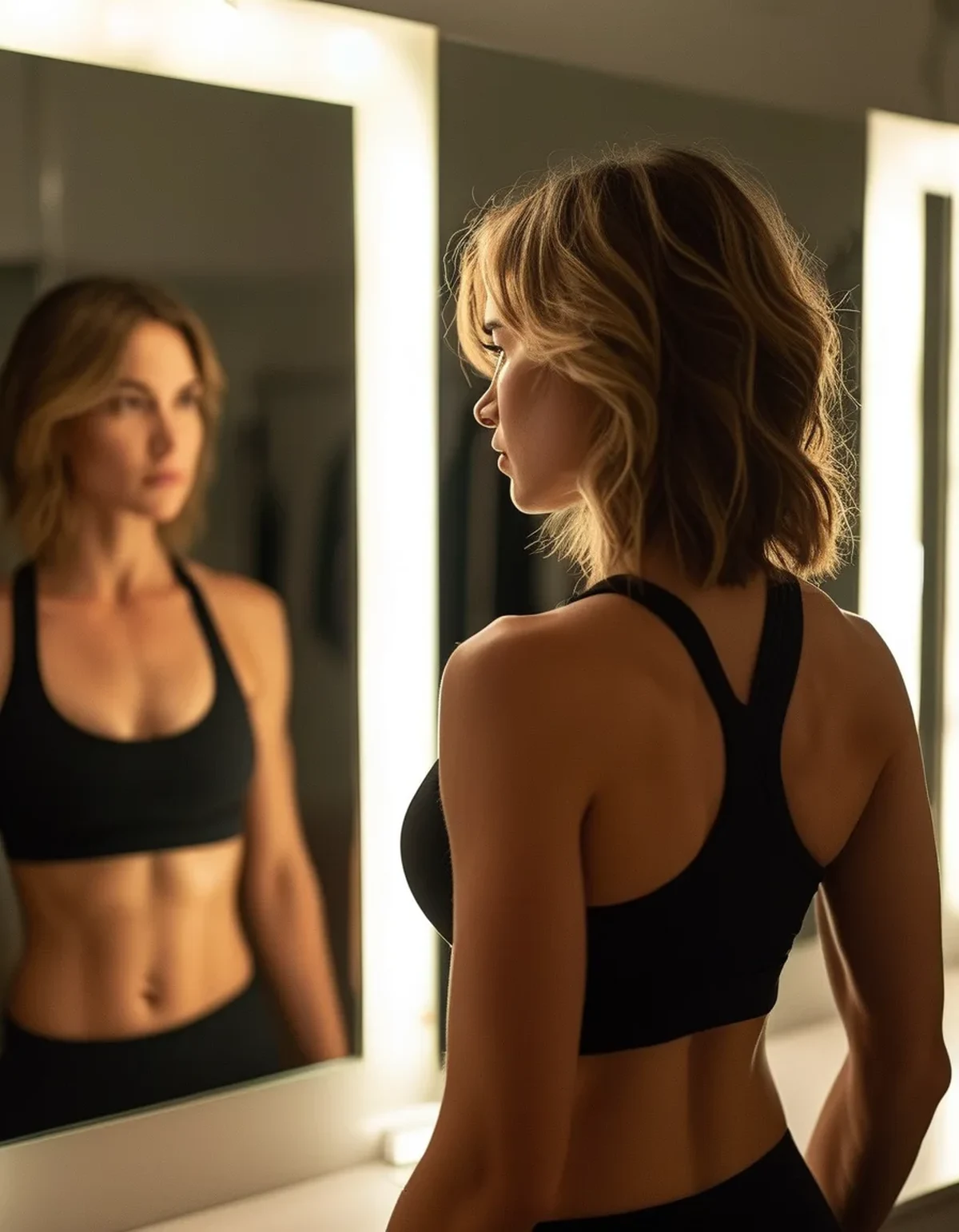
It looked right in the mirror and it felt right on the hanger walk back to the desk.
And twelve minutes into the class the hem is at your ribs and the neckline is doing something new.
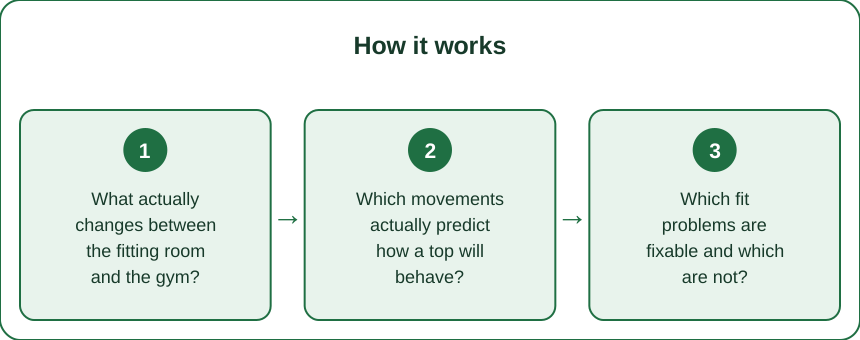
What actually changes between the fitting room and the gym?
Skin temperature rises and blood flow to the skin increases, which makes limbs measurably larger by the end of a warm-up.
Moisture removes the slip layer. Dry fabric slides over dry skin; damp fabric grips it, and a top that grips rides rather than settles.
Time of day matters more than people expect. Bodies are slightly smaller in the morning and larger after a day of eating, drinking and being upright.
You test standing still and wear it moving. A seam that sits neatly at rest can sit directly on a moving joint.
Compression fabrics warm up too. Elastane becomes more compliant at body temperature, so a top that felt firm in a cool shop feels softer after ten minutes.
And you assess in flat, even shop lighting rather than in the mirror wall of a busy studio, which changes how much you notice about coverage.
Which movements actually predict how a top will behave?
Both arms straight overhead. This is the single most informative test, because it shows exactly how far the hem travels and whether it comes back down.
A slow forward fold. This reveals neckline gaping, which is invisible standing upright and impossible to fix later.
A plank hold, or hands on a bench in plank position. Shows what the fabric does when your torso is horizontal and the top is hanging away from you.
A twist to each side. Reveals whether side seams sit on your ribs or drag across them.
Reaching across to the opposite shoulder, which is what tests the armhole and the strap rather than the body of the garment.
And crucially, do all of these and then look again - the question is not what the top does during the movement, it is whether it returns.
Which fit problems are fixable and which are not?
Hem riding up: sometimes fixable. A longer body, a silicone gripper hem, or a slightly less fitted cut solves it. A short top on a long torso does not get better.
Neckline gaping in a forward bend: not fixable. The pattern is wrong for your frame and no amount of adjustment changes it.
Underarm tightness: not fixable, and it is the fastest route to chafing on a long session.
Fabric cling once damp: partly fixable with a different fabric weight or a looser cut, but not by sizing up in the same style.
Straps digging: fixable with a wider strap or a racerback, and usually a sign the top is carrying support it was not built for.
And a top that is only slightly too small: not worth it. Warm and damp, slightly too small becomes distinctly too small around the fifteen-minute mark.
Myth vs Fact: Trying On Activewear
Myth: if it feels tight in the shop it will stretch to fit.
Fact: performance fabrics are engineered to recover, not to relax. They warm and soften slightly but they do not permanently stretch the way cotton does. What you feel in the shop is roughly what you get.
Myth: you should size up for comfort.
Fact: a support top that is too large stops supporting, and excess fabric bunches under a sports bra and chafes. Size up in the cut, not in the number - a relaxed style in your size beats a fitted style one size up.
Myth: the mirror tells you enough.
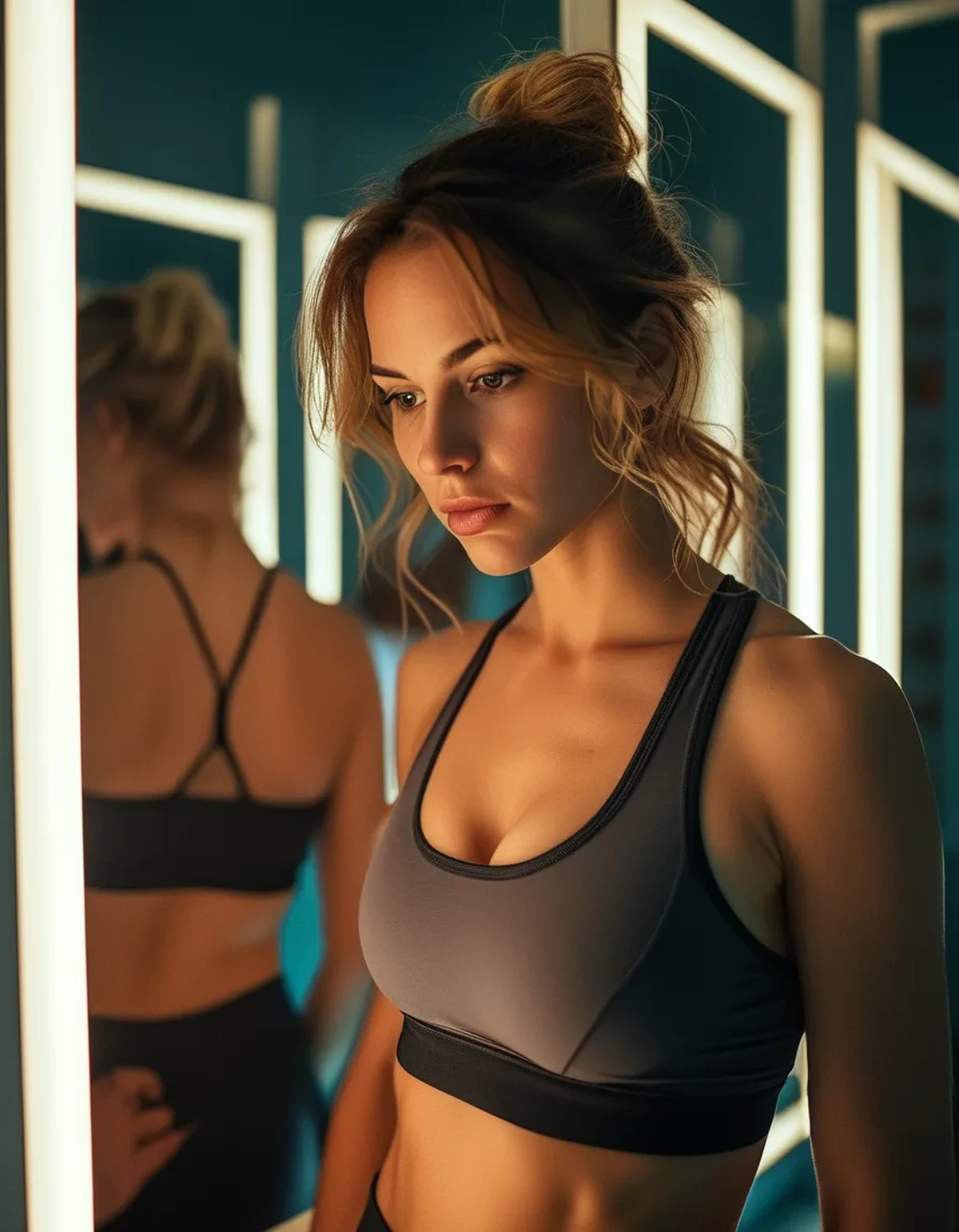
Fact: the mirror tells you about a still body in cool, dry conditions in flat light. It cannot tell you about hem travel, damp cling, or an armhole that saws at your underarm on rep 40. Movement testing tells you all three in about 20 seconds.
Myth: brand sizing is consistent within a brand.
Fact: cuts vary substantially by product line even within one label, and a fitted training line and a relaxed lifestyle line rarely share a fit block. Your size in one style is a starting guess for another.
Myth: a slightly short top is fine because you will pull it down.
Fact: you will pull it down roughly 200 times per session, and the constant adjusting is a real distraction. It is also what wears out the hem first.
What about the late-summer version of this problem?
Humidity is the variable that changes most right now. A top tested in an air-conditioned shop behaves differently in a humid August studio where nothing dries.
Sweat arrives faster and stays longer in humidity, so the damp-cling phase starts at minute five rather than minute twenty.
Lighter, more open knits move air and are worth the trade in coverage while it is still warm.
Sunscreen residue affects fabric feel and is a genuine factor for anyone training outdoors before moving inside.
Layering season is a few weeks away, and a top that only works alone is worth knowing about before it goes under something in October.
And this is the discount window, which is exactly when people buy summer tops that fit poorly because the price made the movement test feel unnecessary.
FAQ: Workout Top Fit Questions, Answered
What time of day should I try on activewear?
Afternoon or evening, when your body is closer to the size it will be at an evening class. Morning fittings run slightly small on the day.
Should I try it on over a sports bra?
Yes, and over the actual bra you train in. A built-in-support top over a different bra tells you very little.
How do I test for chafing before buying?
Feel the seams at the underarm and along the side. Flat, bonded or offset seams are far better than a raised seam sitting directly in the crease.
Is it worth buying two sizes and returning one?
Often, especially online, provided you do the same movement test on both rather than choosing by the mirror.
Why does the same size fit differently in the same brand?
Different product lines use different fit blocks and different fabric compositions. Treat each line as its own sizing.
Does washing change the fit?
Slightly, and mostly in the first few washes as any finishing treatment comes off. Fabric softener does the most damage to the recovery you paid for.
TL;DR:
- Fitting rooms test a cold, dry, still body; the gym tests a warm, damp, moving one.
- Moisture removes the fabric’s slip against skin, which is what turns a settled hem into a riding one.
- Arms overhead, forward fold and a plank hold predict nearly all real-world fit problems.
- Gaping necklines and tight armholes are not fixable; hem length and strap width often are.
- Try on in the afternoon, over your actual sports bra, and judge by whether the top returns after movement.
The mirror is not lying to you. It is just answering a different question than the one you need answered.
See It in Motion
Seen here: Crewneck Short Sleeve Workout T-Shirt — shop it on bubblelime.com
Keep Reading
This article is for general informational and styling purposes only. Fit, sizing, and product availability may vary.