The Seam Placement Detail That Causes Most Workout Top Chafing
Quick Answer: Most workout-top chafing comes from flat-felled or overlocked seams positioned directly under the arm or along the side body, where repetitive arm swing creates constant friction. Tops with seams shifted slightly forward or back of these exact friction points, or genuinely flatlock/seamless construction, prevent the vast majority of this chafing.
The same workout top can feel totally fine for a 20-minute session and become a real problem by mile 6 of a run — and it usually comes down to exactly where the seams sit relative to your arm swing, not the fabric itself.

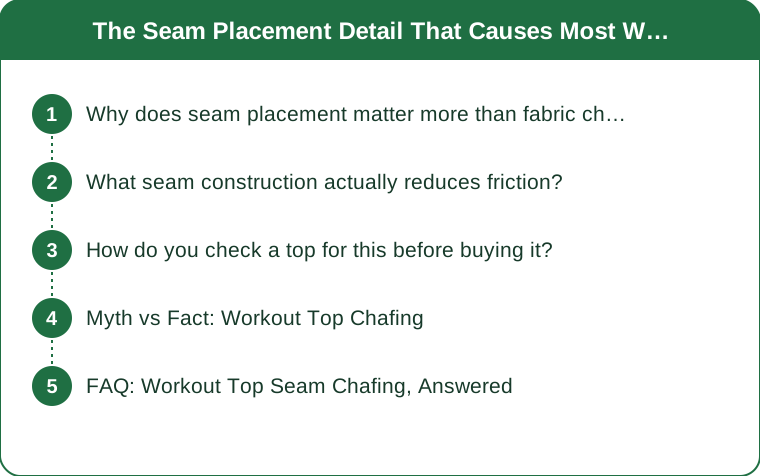
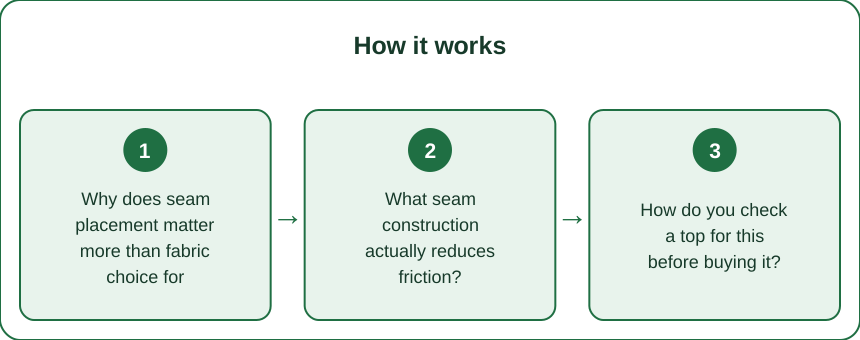
Why does seam placement matter more than fabric choice for chafing?
Fabric affects moisture and heat, but chafing itself is a friction problem, and friction is concentrated wherever a seam crosses a high-movement zone — directly under the arm and along the side body during arm swing are the two most common culprits. A soft, moisture-wicking fabric with a seam sitting exactly in that friction zone will still chafe, while a less premium fabric with well-placed seams often won’t.
What seam construction actually reduces friction?
Flatlock seams (where the fabric edges overlap and are sewn flat rather than creating a raised ridge) sit much closer to the skin without the raised edge that a standard overlocked seam creates. Fully seamless knit construction, common in some higher-end running and training tops, removes this friction point entirely by knitting the garment in one piece rather than sewing panels together.

How do you check a top for this before buying it?
Run a finger along the underarm and side-body seam — if you feel a raised, ropey edge rather than a flat one, that’s a flatlock or standard seam likely to cause friction over a longer session. Also check where the seam sits when you raise your arm as if running: seams positioned right where the arm meets the torso are the highest-risk placement.
Myth vs Fact: Workout Top Chafing
Myth: More expensive fabric always means less chafing. Fact: Seam construction and placement matter more than fabric price point — a budget top with well-placed flatlock seams can outperform a premium fabric with poorly placed standard seams.
Myth: Chafing only happens on very long runs or workouts. Fact: Poor seam placement can cause noticeable irritation in under 30 minutes, especially in humid conditions or with repetitive arm-swing activities like running.
FAQ: Workout Top Seam Chafing, Answered
Are seamless tops always better than seamed ones?
For chafing-prone areas, generally yes, but seamless construction can be less structured for support-focused tops — the tradeoff depends on your priority (chafing prevention vs. shaping and support).
Does applying anti-chafe balm fix a poorly placed seam?
It helps temporarily but doesn’t solve the underlying issue — for recurring chafing at the same spot, replacing the garment is more effective than repeated balm application.
Should I size up to avoid chafing from tight seams?
Sizing up can help if the top is simply too tight and pulling seams against your skin, but if the fit is correct and chafing persists, seam placement — not size — is the more likely cause.
TL;DR:
- Chafing is a friction problem concentrated at seams crossing high-movement zones, not just a fabric issue
- Flatlock or seamless construction sits flatter against skin and causes far less friction
- Check seam texture and placement (especially underarm) before buying, not just fabric feel
- Fixing recurring chafing usually means replacing the garment, not just applying more balm
Before blaming your skin or the weather for chafing, run a finger along the seam — it’s often the real culprit.
See It in Motion
Seen here: Racerback Tank Top - White — shop similar styles on bubblelime.com
Keep Reading
This article is for general informational and styling purposes only. Fit, sizing, and product availability may vary.