Why Your Workout Top Sticks to You in Humidity — and What Actually Fixes It
Quick Answer: Moisture-wicking works by pulling sweat to the fabric surface so it can evaporate — and in high humidity the air cannot accept much more water vapor, so evaporation stalls and the fabric stays saturated against your skin. The fix is airflow and reduced contact area, not better wicking: looser cuts, textured or open-knit fabrics, mesh panels, and fewer flat-against-skin surfaces.
You bought the good technical top. On a dry day it is magnificent. On an 85 percent humidity morning it is welded to your ribs by minute twelve.
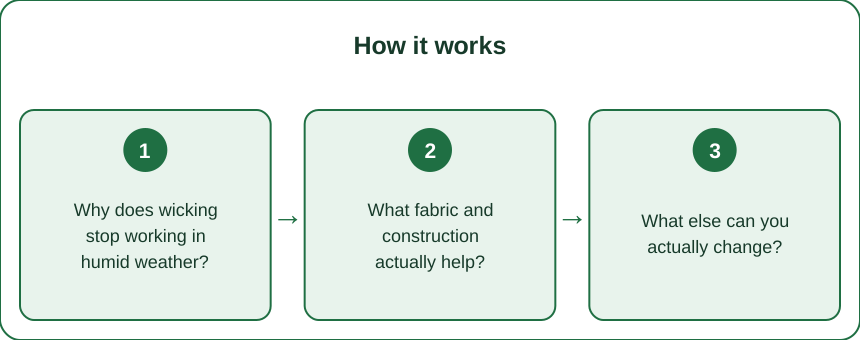
The fabric is not failing — it has hit a physical limit. The third section covers what to look for instead of another wicking claim.
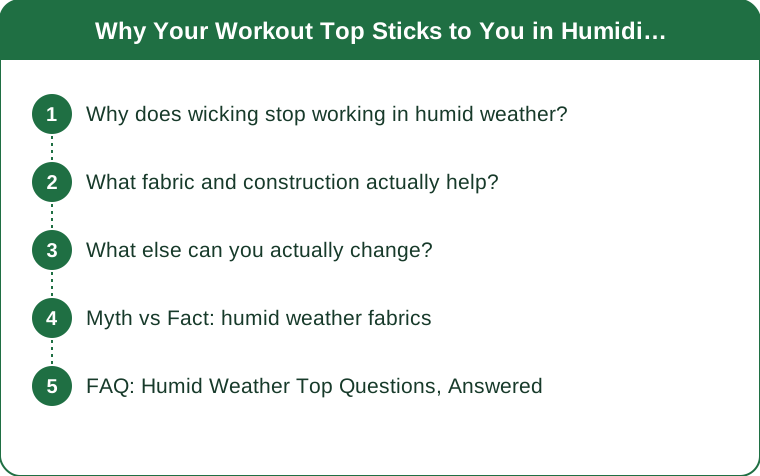
Why does wicking stop working in humid weather?
Because wicking and drying are two separate steps, and humidity kills the second one.
Step one: wicking. Capillary action in the fabric structure pulls liquid sweat off your skin and spreads it across a larger surface area. This works fine in humidity — it is a property of the fabric, not the air.
Step two: evaporation. Once spread out, the sweat evaporates into the air, which is what actually cools you and what dries the fabric. This depends entirely on the vapor pressure gradient between the wet fabric and the surrounding air.
At 85 percent relative humidity, the air is already nearly saturated. It can accept very little additional water vapor, so evaporation slows dramatically. The fabric wicks sweat off your skin, spreads it, and then holds it — because there is nowhere for it to go.
The result is a saturated fabric sitting against your skin, which is heavy, clingy, and does almost nothing for cooling. It also feels worse than no shirt at all, which is the specific complaint.
This is also why humid conditions are so much harder physiologically. Evaporative cooling is your primary heat loss mechanism during exercise, and humidity suppresses it. You sweat more, you cool less, and the sweat runs off rather than evaporating — losing fluid without the benefit.
So the design problem changes: in dry conditions you want maximum wicking and spreading. In humid conditions you want maximum airflow over the smallest possible wetted area.
What fabric and construction actually help?
The features that matter shift completely once humidity is the constraint.
Airflow beats wicking. Open-knit, mesh, and perforated fabrics let moving air reach the wet surface, which is the only way evaporation happens when the air is nearly saturated. Air movement across a wet surface refreshes the boundary layer of humid air sitting right against it.
Textured fabrics reduce contact area. Waffle knits, ribbed textures, seersucker-like puckers, and burnout patterns all hold the fabric slightly off your skin, which does two things: it reduces the clammy sticking sensation, and it creates a small air gap where evaporation can occur.
Looser cuts win. A fitted top has maximum skin contact by design. A relaxed or A-line cut lets air move between fabric and skin with every movement, which is genuinely the largest single improvement available.
Fewer, flatter seams. Seams are thicker and hold more moisture, and a saturated seam against the skin is a chafing risk in humidity.
Fabric weight matters more than fiber type. A lightweight polyester open knit outperforms a heavier one regardless of the marketing. Hold the fabric up to a light — if you can see through the knit structure, air can move through it.
Merino is a genuine exception worth knowing. Wool absorbs a substantial amount of moisture into the fiber itself before feeling wet, so merino tends to feel less clammy at the same saturation and manages odor well. It does dry more slowly. For humid conditions many people find a lightweight merino blend more comfortable than pure synthetic despite the slower drying.
Color matters outdoors — lighter colors reflect more radiant heat, which is a separate benefit that stacks.
What else can you actually change?
Several things, and some of them matter more than the top.
Reduce coverage. The simplest, most effective change. A tank or a crop with a sports bra removes fabric contact entirely from the areas that suffer most. If you are outdoors in strong sun, that has to be balanced against UV exposure — a very open-knit long sleeve can be a better trade than a fitted tank.
Chafe-proof before you need to. Wet fabric plus movement is the chafing scenario, and humid conditions produce it reliably. Anti-chafe balm at the underarm, bra band, and any seam line costs nothing and prevents the thing that ends humid workouts early.
Change tops mid-session for long efforts. A dry top at the halfway point of a two-hour session is a bigger comfort upgrade than any fabric technology. Keep a spare in the car.
Train where air moves. Shade with a breeze beats shade without one. A fan indoors is not a luxury in humid conditions — it is the evaporation mechanism you are otherwise missing. For indoor training this is the single biggest lever available.
Pre-cool and use cold water externally. A cold towel or cold water on the neck and wrists provides direct cooling that does not depend on evaporation at all.
Adjust expectations for pace. Perceived effort at the same workload is genuinely higher in humidity, and heart rate drifts upward. That is not a fitness regression. Train by effort rather than by pace on humid days, and take heat symptoms seriously — dizziness, chills, or confusion mean stop and cool down. This is general information, not medical advice.
Myth vs Fact: humid weather fabrics
Myth: A better wicking fabric will solve clinging in humidity.
Fact: Wicking is not the bottleneck — evaporation is. A fabric that wicks more aggressively in saturated air just spreads the same amount of trapped moisture. What changes the outcome is airflow and reduced contact, which is a construction and cut question, not a fiber technology question.
Myth: Cotton is always the wrong choice.
Fact: Cotton is genuinely poor for most training — it absorbs a lot of water, gets heavy, stays wet, and chafes. In extreme humidity the gap narrows somewhat because nothing is drying anyway, but cotton still holds more weight and chafes more. Synthetics and merino remain better choices. The one place cotton makes sense is a loose overshirt for a walk, not a training top.
Myth: Tighter compression tops manage sweat better.
Fact: They have maximum skin contact, which is exactly wrong for humidity. Compression has legitimate uses; humid weather comfort is not one of them.
Myth: Antimicrobial treatments stop humid-weather odor.
Fact: They help and they are not permanent. Treatments wash out over time, and detergent buildup in the fabric traps the bacteria that cause odor. A periodic strip wash restores performance more than a new antimicrobial claim does.
FAQ: Humid Weather Top Questions, Answered
Is merino really worth it in hot weather?
For many people, yes — lightweight merino manages odor far better than synthetics and feels less clammy at the same level of saturation, because moisture is absorbed into the fiber rather than sitting on the surface. The trade-offs are cost, slower drying, and durability. A merino-synthetic blend is often the practical middle ground.
Why does my top smell worse after humid workouts even when washed?
Because humid sweat sits in the fabric longer, and because detergent and softener buildup in synthetics traps odor-causing bacteria. The fix is a periodic strip wash — a hot wash with no detergent, or with a small amount of a residue-removing product — and never using fabric softener on technical fabrics. Also, never leave a damp top in a gym bag; that is where permanent odor is created.
Does a looser top really make that much difference?
Yes, and it is usually the biggest single improvement available. Airflow between fabric and skin is what allows any evaporation at all when the air is nearly saturated, and a fitted top eliminates that gap by design. If you try one change, try a relaxed cut in an open-knit fabric.
TL;DR:
- Wicking still works in humidity; evaporation is what stalls, so the fabric wicks and then holds the sweat.
- Airflow and reduced skin contact beat better wicking — open knits, textures, mesh, and looser cuts.
- Fabric weight and knit openness matter more than any marketing term; hold it to the light.
- Lightweight merino feels less clammy at the same saturation and handles odor better, at the cost of drying speed.
- A fan indoors, a spare top for long sessions, and anti-chafe balm do more than any fabric upgrade.
The useful shift here is realizing you are solving a different problem than the one your dry-weather gear was designed for. Once you stop looking for a better wicking claim and start looking for a top you can see light through, humid-weather training gets considerably less miserable.
See It in Motion
Keep Reading
This article is for general informational and styling purposes only. Fit, sizing, and product availability may vary.