Why Your Workout Tops Start Clinging in Autumn
Quick Answer: Static builds when air is dry, and autumn brings both lower outdoor humidity and indoor heating that dries the air further. Synthetic activewear generates and holds static charge readily, so the same top that behaved all summer starts clinging in October. Add moisture to the fabric or the air. Fabric softener is the obvious answer and the wrong one for activewear.
Summer cling is wet fabric on damp skin.
Autumn cling is dry fabric holding a charge, and nothing that fixed the first one helps.

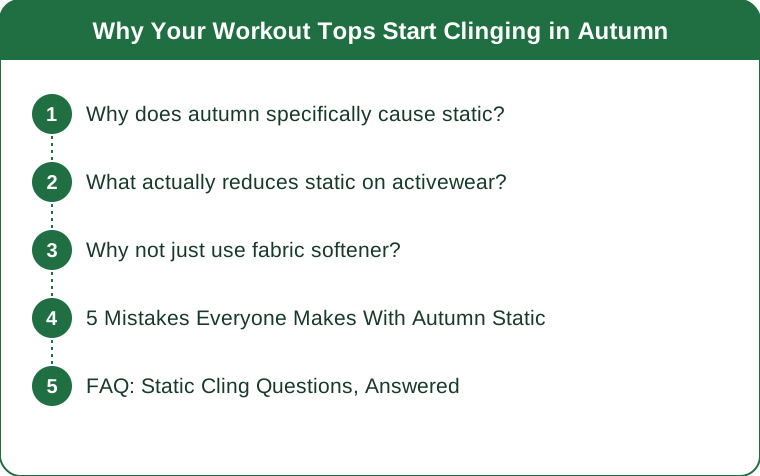
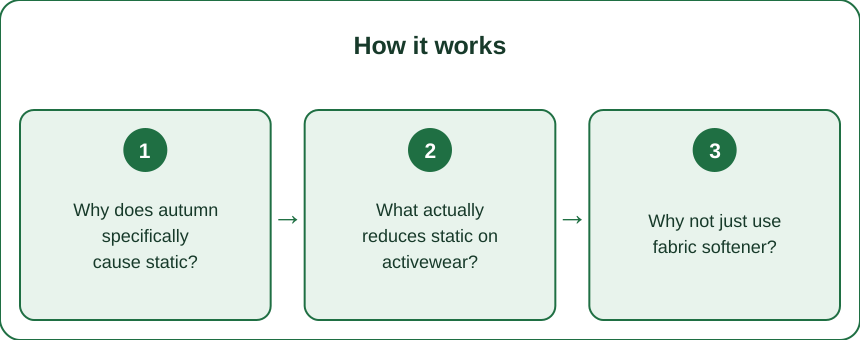
Why does autumn specifically cause static?
Because static needs dry air, and autumn supplies it from two directions.
Charge builds when materials rub and separate. Fabric moving against skin and against other fabric transfers charge continuously, all year round. The rubbing is not the variable - what happens to the charge afterwards is.
Humid air lets charge dissipate. Moisture in the air provides a path for charge to bleed away almost as fast as it builds. In summer, static builds and immediately leaves, which is why nobody thinks about it.
Dry air traps it. As humidity falls, the charge stays on the fabric and accumulates, until the garment is attracted to your skin, your legs, or itself. The cling is accumulated charge, not a change in the fabric.
Indoor heating dries the air far more than the weather does. Heated indoor air can be considerably drier than outdoor air, which is why static is worst indoors in autumn and winter. The first week of heating is when everyone notices.
Synthetics generate and hold charge more than natural fibres. Polyester and nylon are excellent insulators, which is exactly why they hold a charge well. Activewear is unusually prone to this for the same reasons it performs well.
And layering multiplies it. Two synthetic layers rubbing against each other generate considerably more charge than one layer against skin. Autumn layering is the aggravating factor that summer did not have.
What actually reduces static on activewear?
Add moisture, or add a conductive path, without coating the fabric.
Air dry rather than tumble dry. Tumble drying is the largest single static generator in the whole process - hot dry tumbling with fabric rubbing constantly. Air drying nearly eliminates it, and protects elastane at the same time.
If you must tumble dry, take it out slightly damp. Fabric that is completely dried in a hot drum is at maximum charge. Removing it a few minutes early and finishing on a rack solves most of the problem.
Use wool dryer balls. They reduce tumbling friction and help fabric separate, which cuts static noticeably without coating anything. They are the practical dryer solution for people who will not air dry.
Raise the humidity in the room. A humidifier, drying laundry indoors, or simply a bowl of water near a radiator all help. This fixes every garment at once, rather than one at a time.
Moisturise your skin. Dry skin holds charge as readily as dry fabric, and the interface between the two is where the cling happens. Autumn skin care doubles as static control, which people rarely connect.
And a light mist of water on the garment works immediately. Not elegant, entirely effective, and it evaporates in minutes. For a top that clings on the way out the door, this is the thirty-second fix.

Why not just use fabric softener?
Because it works by doing exactly what activewear must not have done to it.
Softener works by coating fibres. That coating reduces friction and holds a little moisture, which is genuinely effective against static. The coating is the mechanism, and it is the problem.
Coated synthetic fabric stops moving moisture. The whole point of performance fabric is wicking sweat away from skin, and a softener coating blocks it. You trade static for a top that holds sweat, which is a considerably worse outcome.
It also traps odour. The residue holds bacteria and odour compounds against the fabric, which is why softener-treated activewear develops persistent smells. This is the most common cause of gear that smells even after washing.
Dryer sheets do the same thing. They are softener delivered in the dryer, with the same coating and the same consequences. The convenience is not worth it for technical fabric.
Vinegar in the rinse is the better alternative. A small amount of white vinegar softens water and reduces static without leaving a coating, and it helps with detergent residue too. It does not leave a smell once dry, contrary to expectation.
And if a garment already has softener buildup, strip it. A hot wash with vinegar and no detergent, run once or twice, removes a lot of accumulated residue. Wicking often returns noticeably afterwards.
5 Mistakes Everyone Makes With Autumn Static
Reaching for fabric softener. It solves static and disables the fabric, which is a bad trade for anything technical. The problem it creates is permanent until you strip the residue.
Over-drying in the tumble dryer. Bone dry equals maximum charge, plus heat damage to elastane. Pull it out damp or skip the dryer entirely.
Layering two synthetics directly. Two insulating layers rubbing together is the ideal static generator. A natural fibre base layer breaks the cycle better than any treatment.
Ignoring skin dryness. Half the interface is your skin, and autumn skin is drier than summer skin. Moisturising works, and nobody thinks of it as a laundry solution.
Assuming it means the garment is worn out. Static is an environmental effect, not fabric degradation. A brand new top will do it too in a dry heated room.
And the bonus mistake: spraying anti-static products directly onto technical fabric. Most work the same way softener does - by coating. Check what you are spraying before you disable a good top.
FAQ: Static Cling Questions, Answered
Does static damage the fabric?
No - it is a surface charge, not a change to the fibres. It is purely an annoyance, which is why the fixes are all about air and moisture rather than the garment.
Why is it worse on some tops than others?
Fibre content and finish both matter, and lighter, smoother synthetics tend to hold charge more readily. Blends with natural fibres are usually noticeably better.
Will a humidifier actually help?
Meaningfully, yes - static drops sharply once indoor humidity rises out of the very dry range. It fixes every garment in the house at once, which makes it the highest-leverage single change.
TL;DR:
- Static needs dry air - autumn weather plus indoor heating supplies it from both directions.
- Synthetics hold charge well because they are good insulators, which is why activewear is prone to it.
- Air dry, or pull garments out of the dryer damp - over-drying is the single biggest generator.
- Never use fabric softener or dryer sheets on activewear - the coating blocks wicking and traps odour.
- Raise indoor humidity and moisturise your skin - half the interface is you.
When the heating goes on this year, move your activewear to a drying rack. Static and elastane damage both disappear in one change.
See It in Motion
Seen here: Round Neck Long Sleeve Athletic T-Shirt — shop it on bubblelime.com
Keep Reading
This article is for general informational and styling purposes only. Fit, sizing, and product availability may vary.